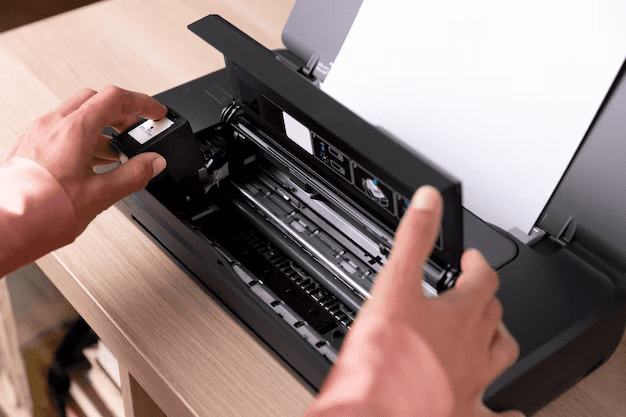

TL;DR: Common printer error codes usually point to paper jams, low ink or toner, cartridge problems, open covers, or internal hardware issues. The fix depends on the exact code and printer model, so identify the error first, then troubleshoot the specific problem.

In this guide:
- Do printer error codes change between brands?
- 1. Paper jam
- 2. Out of paper
- 3. Low or empty ink or toner
- 4. Cartridge not recognized
- 5. Door or cover open
- 6. Ink absorber or waste ink pad full
- 7. Hardware or internal printer error
- Wrapping up
- FAQs
You need to print something in the next five minutes, and that’s exactly when your printer picks a fight. Maybe there’s a paper jam, the ink is running on fumes, or a cryptic string of numbers just took over the display and you have no idea what it’s telling you.
Printer error codes exist to point you toward the problem, but they’re not exactly user-friendly. The same jam can show up as “E3” on one machine and “1300” on another, which makes searching for a fix more confusing than it needs to be. This guide walks through what the most common error codes actually mean, why they look so different between brands, and how to clear them without calling in backup every time.
If your printer is showing as offline instead of displaying an error code, start with the connection and print queue instead.
Do printer error codes change between brands?
Short answer: the problem is often identical, but the code used to describe it almost never is.
Every manufacturer builds its own firmware and its own system for detecting and reporting faults. A paper jam on an HP LaserJet might show up as E3 or a code in the 13.XX.XX range. That same jam on a Brother machine could just say “Jam Tray” on the display. Epson tends to lean on codes like E-01, while Canon uses four-digit support codes such as 1300 or 1303. None of these numbers translate across brands, so seeing a code on your printer doesn’t tell you anything about what that same code would mean on your neighbor’s.
Here’s how the most common issues tend to break down across the major brands:
| Common Error | HP | Brother | Epson | Canon |
| Paper Jam | E3 or 13.XX.XX on some models | Jam Tray / model-specific messages | E-01 or model-specific codes | 1300 / 1303 on some models |
| Out of Paper | Out of Paper / model-specific code | No Paper / model-specific code | Model-specific status code | 1000 on some models |
| Low/Empty Ink or Toner | Low Ink / model-specific message | Toner Life End / Replace Toner | Model-specific ink status | 1680 / 1688 on some models |
| Cartridge Not Recognized | Incompatible Ink / model-specific | Cannot Detect / model-specific | Recognize Ink / model-specific | 1401 / 1684 on some models |
| Door or Cover Open | Door Open / model-specific | Cover is Open | Model-specific message | 1200 on some models |
| Ink Absorber / Waste Ink Full | Model-specific service message | Unable to Print 46 on some models | Service Required / model-specific | 5B00 / 5B01 on some models |
| Critical Hardware Error | 50.X / 59.X on some LaserJets | Print Unable / Machine Error | Fatal Error / model-specific | B200 / other model-specific |
Treat this table as a starting point rather than a lookup chart you can trust blindly. Even within the same brand, two models can assign completely different meanings to the same code, so always cross-check against your specific printer.
1. Paper jam

What it means:
Usually, there’s paper stuck somewhere along the paper path. But don’t assume you’ll always see a crumpled sheet sticking out. The printer can also trigger a jam error when a sensor thinks the paper didn’t feed correctly.
Why it happens:
A sheet may have folded or become misaligned while feeding, dust or debris may have built up on the rollers, or a small piece of paper from a previous jam may still be inside the printer.
How to fix it:
- Turn off the printer and carefully remove the jammed paper.
- Check the paper path carefully for small scraps of paper that may be difficult to see.
- Clean accessible rollers with a soft, lint-free cloth according to the manufacturer’s instructions.
- Make sure the paper is properly aligned and that the tray isn’t overloaded.
👀 Tip: Don’t yank the sheet straight out if it feels stuck. Pull slowly in the direction the paper normally travels whenever possible; forcing it backward can tear the sheet or damage the rollers.
If this keeps happening even after you’ve cleared the paper path, see how to fix recurring paper jams and prevent another sheet from getting stuck.
2. Out of paper

What it means:
The printer isn’t detecting paper in the tray it’s trying to use. That can happen even when you can clearly see paper sitting there.
Why it happens:
The tray may be empty, the paper may not be loaded correctly, the guides may be too tight or too loose, or the pickup rollers may be dirty or worn.
How to fix it:
- Load the correct paper size and type for your print job.
- Adjust the paper guides so they fit snugly against the stack without squeezing it.
- Make sure the paper is sitting correctly in the tray and isn’t bent or sticking together.
- If the printer still doesn’t detect the paper, check the pickup rollers for dust or debris and clean them according to the manufacturer’s instructions.
3. Low or empty ink or toner

What it means:
The printer has detected that one of its ink cartridges, ink tanks, or toner cartridges is low or empty.
Why it happens:
Your ink or toner may actually be running low, but the warning can also appear after installing a new cartridge if it isn’t seated correctly or the printer hasn’t recognized it yet. Some printers estimate remaining ink or toner rather than measuring it directly, so the warning doesn’t always mean the cartridge is completely empty.
How to fix it:
- Check which cartridge or toner is low.
- Replace the cartridge or toner if it is empty.
- If your printer uses refillable ink tanks, refill them with the correct ink according to the manufacturer’s instructions.
- If you’ve recently replaced the cartridge but the warning remains, make sure it is installed correctly and that the printer recognizes it.
⭐ Tip: Some laser printers may continue printing after a low-toner warning. You may be able to get a few more pages before replacing the cartridge, depending on the model.
Not sure whether you can keep printing or actually need a new cartridge? Check the signs it’s time to replace your toner or ink before swapping it out.
4. Cartridge not recognized

What it means:
The printer can tell that a cartridge is installed, but it can’t identify it or communicate with it correctly.
Why it happens:
The cartridge may not be seated correctly, the contacts may be dirty, the cartridge may be incompatible, or the printer may have trouble reading its chip.
How to fix it:
- Remove the cartridge and reinstall it, making sure it clicks securely into place.
- Check the cartridge and the printer contacts for dust or debris.
- If cleaning is recommended for your specific model, carefully clean the contacts using the manufacturer’s instructions.
- Make sure the cartridge is compatible with your exact printer model.
- If the problem started after a firmware update, check the manufacturer’s support documentation for compatibility information before making any changes to the printer’s firmware settings.
5. Door or cover open

What it means:
The printer detects that one of its covers, doors, or access panels is not completely closed.
Why it happens:
A cover may simply not be fully closed, or a piece of paper or another object may be preventing it from closing properly.
How to fix it:
- Open and close the printer’s accessible covers firmly.
- Check the paper path and cartridge area for anything preventing the cover from closing.
- Make sure no paper, packaging material, or debris is caught around the cover.
- If the error remains even though everything is properly closed, the cover sensor or switch may need professional attention.
6. Ink absorber or waste ink pad full

What it means:
Inkjet printers collect excess ink from cleaning and maintenance cycles in an internal absorber or waste ink pad. When the printer estimates that it has reached its service limit, it may stop printing and display a service-related error.
Why it happens:
The waste ink absorber has reached the manufacturer’s programmed limit or requires maintenance.
How to fix it:
- Check the printer manufacturer’s support instructions for the specific error code.
- Some models require the waste ink absorber or maintenance box to be replaced.
- Certain printers may also require the internal waste-ink counter to be reset after the physical component has been serviced.
- If you’re not comfortable opening the printer, have a professional technician handle the repair.
💡 Important: Simply resetting the counter without addressing a physically saturated waste-ink component can lead to ink leakage.
7. Hardware or internal printer error

What it means:
The printer has detected a problem it can’t resolve through normal operation, often involving an internal component such as the printhead, carriage, motor, or sensor.
Why it happens:
Possible causes include a malfunctioning motor, printhead issue, carriage obstruction, sensor failure, electrical problem, or another internal hardware fault.
How to fix it:
- Turn the printer off and disconnect it from power.
- Wait a few minutes before reconnecting it and turning it back on.
- Check for obvious obstructions, such as paper scraps, clips, or other objects inside the printer.
- If the printer has an accessible print carriage, check the manufacturer’s instructions before attempting to move it manually.
- If the error returns after restarting the printer, check the manufacturer’s support documentation or contact a qualified technician.
🛠️ When to call a professional?
If the printer continues displaying a critical hardware error after basic troubleshooting, avoid repeatedly restarting it or forcing internal components to move. A technician may need to inspect the printer and determine whether a component needs repair or replacement.
Wrapping up
Printer error codes look intimidating mostly because they’re inconsistent. A paper jam, cartridge problem, or maintenance warning can have a completely different code depending on the brand and model. Once you know what the message is actually pointing to, though, troubleshooting gets much easier.
Many everyday printer errors can be handled at home by checking the paper path, reseating a cartridge, or following the manufacturer’s reset instructions. If the same code keeps coming back, especially one tied to a motor, printhead, sensor, or other internal component, it may be time to stop troubleshooting and have the printer checked professionally. Geeks on Site offers printer repair and installation services for HP, Canon, Epson, Brother, and other common printer brands.
FAQs
How do I get my printer out of error mode?
Start by checking the message or error code on the printer’s display instead of resetting it repeatedly. A paper jam, empty tray, cartridge problem, or open cover may need to be fixed before the error will clear. If the message remains after you’ve addressed the problem, restart the printer and check the manufacturer’s instructions for your specific model.
Why does my printer show an error even when nothing looks wrong?
Some printer errors are triggered by sensors, so the problem isn’t always visible. A tiny piece of paper may be stuck inside, a cartridge may not be seated correctly, or a paper or cover sensor may not be detecting things as expected. The exact error code can help narrow down where to look.
How do I clear an error code on my HP printer?
Write down the exact error code and check it against your specific HP printer model. Different codes can point to paper-feed problems, cartridges, connectivity, or internal hardware, so following the troubleshooting steps for that code is more effective than trying random resets.
Why does my printer error keep coming back?
If an error returns after you’ve fixed the obvious problem, something may still be interfering with a sensor or internal component. Repeated paper jams, cartridge errors, or hardware codes can point to worn rollers, dirty contacts, a failing sensor, or another issue that needs closer inspection.
Last Updated on August 24, 2026